
5 Most Common Hotel Guest Questions and How AI Handles Them for You
What questions do guests ask most often, why do they keep repeating, and how can an AI digital guide respond instantly and in the guest's own language.
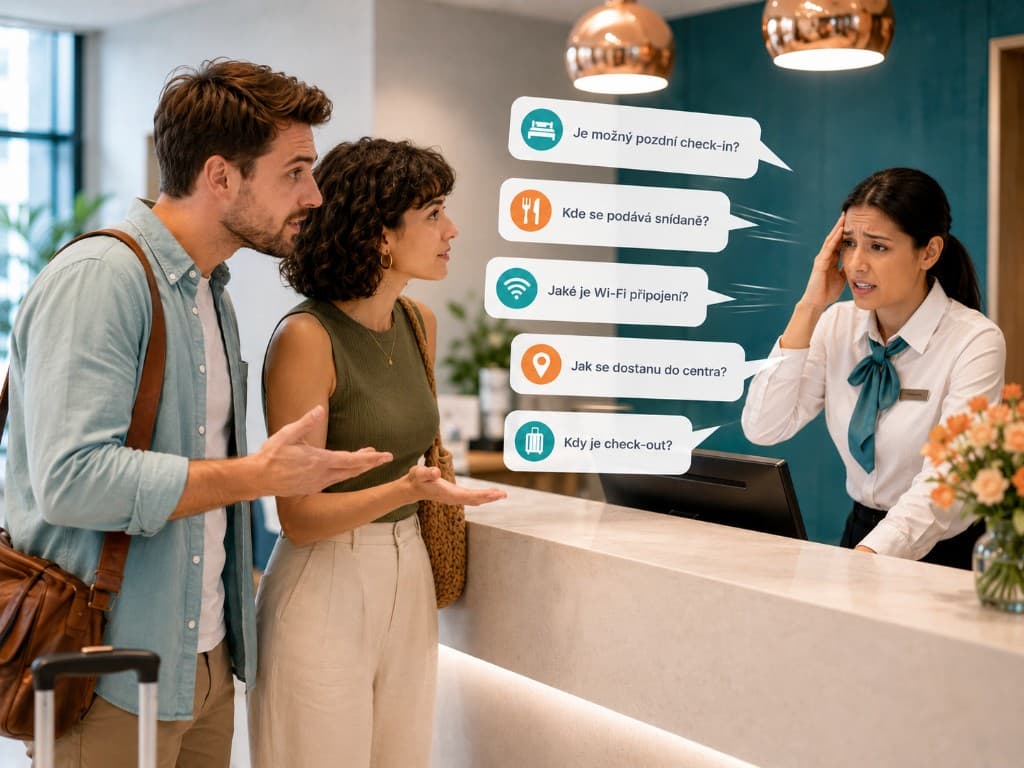
The most common hotel guest questions revolve around Wi-Fi, breakfast and check-out, parking and building access, room equipment, and local recommendations. An AI digital guide can answer these questions instantly, in multiple languages, and according to each property's specific rules.
That doesn't mean it should replace the front desk or the host.
Its job is to handle simple informational queries that repeat every day, and hand off situations that require decision-making, empathy, or personalized help to a real person.
This isn't a universal ranking that applies to every hotel either. A luxury city hotel, a mountain guesthouse, and a self-service apartment each deal with different guest needs.
Still, a large portion of everyday communication revolves around the same few topics.
Why do guests ask even when they've already received the information?
Instructions may be in the confirmation email, on the website, in a message from the booking platform, or in a paper manual in the room.
The guest still asks.
Not because they deliberately ignored the information. Often, they simply can't quickly find where it is.
Before arrival, guests receive a flood of messages: booking confirmation, payment terms, travel directions, upsell offers, and check-in instructions. A few days later, they may not remember which email contained the Wi-Fi password or the door access code.
From the property's perspective, the information was provided.
From the guest's perspective, it's not available at the moment they need it.
Information a guest can't quickly find is practically as valuable as information they never received.
What do the most common guest questions have in common?
Most of the time, these are questions that are:
- simple,
- predictable,
- repetitive,
- specific to a particular property,
- important at that exact moment.
Answering a single question takes the front desk just a moment. The real problem comes from sheer volume and the fact that they arrive throughout the entire day.
The receptionist has to interrupt another task, read the message, understand the context, respond, and then switch back to what they were doing.
Individual minutes gradually add up to hours.
Guest questions and other feedback also reveal what guests actually consider important during their stay. Research focused on automated analysis of hotel reviews showed that guest evaluations can be used to identify specific areas affecting perceived service quality and leverage them to improve hotel operations.
The same principle applies to everyday questions. If a certain topic keeps coming up, it may signal that guests are missing information or that the current way of sharing it is unclear.
1. What's the Wi-Fi password?
Wi-Fi is one of the first things a guest deals with after arriving at their room.
They need to message their family, get some work done, play a video for the kids, look up transit connections, or plan the next day's itinerary.
The password might be printed:
- on a card on the desk,
- on the TV screen,
- in the hotel manual,
- in an email,
- on the back of the key card,
- on a sign at reception.
But the guest doesn't know exactly where to look.
Why do Wi-Fi questions keep coming up?
The information is placed differently at every property. Sometimes the network name doesn't match the hotel name, or there are multiple networks for different parts of the building.
Problems can also arise when:
- the password is too complex,
- the guest can't distinguish certain characters,
- the network requires additional authentication,
- the login page doesn't open automatically,
- the signal in the room is too weak,
- an outdated information card shows invalid credentials.
How can an AI guide respond?
The guest asks:
What's the Wi-Fi password?
The digital guide can answer:
Connect to the network Hotel Aurora Guest. The password is Aurora2026. If the login page doesn't open automatically, try opening any website in your browser.
The answer can also differentiate by specific building, floor, or apartment.
If some rooms use a different network, the AI needs access to the relevant context. Otherwise, a single generic answer for the entire property could point the guest to the wrong network.
What can property operators learn from these questions?
If Wi-Fi questions keep recurring even after the password is available in the digital guide, the problem may not be about information availability.
It could be:
- a weak signal,
- a broken login page,
- confusing network names,
- an overly complex password,
- a technical issue in a certain part of the building.
AI doesn't just have to answer questions. It can also help uncover recurring operational issues.
2. What time is breakfast and when is check-out?
The second major group consists of time-related and operational questions.
Guests ask things like:
- What time does breakfast start?
- Where is breakfast served?
- Is it open later on weekends?
- Can we come to breakfast earlier?
- What time do we need to leave the room?
- Is it possible to arrange a late check-out?
- Where can we store our luggage after checking out?
At first glance, these are just a few details that belong in a hotel manual.
In reality, though, the answer often depends on additional circumstances.
Why isn't a single generic sentence enough?
Breakfast times can vary:
- on weekends,
- on public holidays,
- during the off-season,
- for larger groups,
- for very early departures.
Late check-out may depend on occupancy, room type, operational capacity, or an additional fee.
An AI guide must not automatically promise a service it cannot confirm.
A good answer might sound like:
Breakfast is served in the ground-floor restaurant from 7:00 to 10:00. On weekends, it's extended until 10:30. If you're departing before 7:00, please contact reception no later than the evening before and we'll check if a breakfast box is available.
For late check-out, the system should explain the rule and then offer to connect the guest with staff:
Standard check-out is by 10:00. A later departure depends on room availability. I can pass your request to reception, but I can't guarantee it without their confirmation.
The AI should reliably explain the rule. It should not approve exceptions on its own unless it has the authority and up-to-date operational information to do so.
3. Where can we park and how do we get inside?
Parking and building access are among the most sensitive informational moments of the entire stay.
Guests often face this situation when they:
- have just arrived after a long drive,
- are parked on an unfamiliar street,
- are blocking traffic,
- it's dark or the weather is bad,
- are traveling with children or luggage,
- can't find the right entrance,
- the access code isn't working.
In moments like these, they don't want a general description of the location.
They need precise, immediately actionable instructions.
What does a good answer look like?
Instead of:
Parking is available behind the building.
a more helpful response would be:
The hotel parking lot is in the courtyard behind the building. From ulice Lidická, turn at the blue gate next to the pharmacy. Use the code from your arrival instructions to open it. Hotel parking spots are marked with the letter H.
An ideal answer might also include:
- a navigation link,
- a photo of the entrance,
- pricing information,
- garage height clearance,
- payment method,
- EV charging availability,
- an alternative when the lot is full.
With access codes, care must also be taken to ensure sensitive information isn't displayed to people who shouldn't have access to it.
When does a human need to step in?
AI can explain the standard procedure. But it shouldn't keep the guest in an endless conversation if:
- the gate isn't responding,
- the code doesn't work,
- the parking lot is full,
- the guest can't enter the building,
- the reservation can't be located,
- a security issue arises.
In those moments, the system must clearly offer escalation:
The standard procedure didn't help in this case. Please call reception or use the button below and we'll connect you with a person.
4. How does the air conditioning, heating, or other equipment work?
Every room is a little different.
A guest may not know:
- how to turn on the air conditioning,
- why the thermostat isn't responding,
- how to operate the blinds,
- where to start the wellness features,
- how to use the coffee machine,
- how to switch the TV input,
- how to turn on the stovetop,
- why the safe won't open.
For staff, the controls are second nature because they know them well.
The guest is seeing them for the first time.
Why is a paper manual often not enough?
The manual may be too long, too technical, or written for a different model of the appliance.
The guest may not even know what the equipment is called. They won't search for a section titled "HVAC system controls" — they'll simply ask:
Why can't we cool down the room?
The AI can match the question to the right instructions and respond in plain language:
The air conditioning only works when the windows are closed. Please close the balcony door, set the controller to the snowflake symbol, and choose your desired temperature. It may take a few minutes for the change to take effect.
The response can be supplemented with a photo of the controller or a short video tutorial.
When is an answer no longer enough?
The system needs to distinguish between:
- unclear controls,
- normal operational limitations,
- an actual technical malfunction.
If the guest has tried the recommended steps and the equipment still isn't working, the AI shouldn't keep repeating the same instructions.
It should escalate the issue to maintenance or reception.
A good solution isn't measured by how many answers it sends automatically, but by whether it actually helps the guest resolve the situation.
5. Where should we eat and what can we do around here?
Guests don't just want information about the hotel.
They also want to get to know the place they've traveled to.
They ask things like:
- Where's a good place to eat?
- Which restaurant is good for kids?
- Where can we go for breakfast?
- Where can we find vegetarian or gluten-free food?
- What can we do if it rains?
- Where can we go for a short walk?
- Where's the nearest pharmacy?
- What's open in the area in the evening?
This is where a digital guide can offer more value than a plain list of search engine results.
The difference between a list and a real recommendation
A list of ten restaurants from a map isn't a personal recommendation.
A more useful answer takes into account:
- the current time,
- distance,
- mode of transportation,
- group composition,
- dietary restrictions,
- weather,
- budget,
- the operator's local knowledge.
For example:
For a family with children, we recommend restaurace U Mlýna, which is a ten-minute walk away and has a kids' play area. The kitchen is open until 9:30 PM. If you're looking for something quieter, Bistro Zahrada has a smaller menu and several vegetarian dishes, but we recommend making a reservation for dinner.
Conversational search for similar recommendations is also used in the broader travel industry. Booking.com, for instance, designed its AI Trip Planner so that travelers can ask a general or very specific question, refine their requirements, and receive answers in a conversational manner.
The biggest risk: outdated information
A restaurant might:
- change its opening hours,
- close down,
- change its menu,
- stop accepting reservations,
- be temporarily closed.
For this reason, the AI shouldn't generate recommendations solely from its general knowledge without verification.
It should work with the operator's vetted tips, and for time-sensitive details, it should allow guests to verify current opening hours or availability.
A local recommendation is only useful when the guest can trust it.
How can AI respond differently than a standard FAQ?
A classic FAQ page works by requiring the guest to:
- open the right page,
- find the relevant category,
- click on the specific question,
- read the prepared answer.
An AI guide enables the opposite approach.
The guest asks a question in their own words:
We'll arrive around one in the morning. Can we still get in?
The system recognizes that the question relates to late arrival and building access, and responds according to the specific property's rules.
The advantage isn't just speed.
The guest doesn't have to navigate the hotel manual's structure. The technology adapts to the way they naturally ask.
What does the AI need to know to answer correctly?
An AI digital guide needs a solid knowledge base.
It should contain at minimum:
- check-in and check-out times,
- arrival instructions,
- parking rules,
- Wi-Fi information,
- breakfast hours and other service schedules,
- equipment instructions,
- house rules,
- contact and emergency procedures,
- vetted local recommendations,
- rules for handing off questions to a human.
It's not enough to upload an old hotel manual once and consider the job done.
The information needs a designated owner, regular reviews, and a clear update process.
If the Wi-Fi password or breakfast time changes, the change must also be reflected in the AI's responses.
Reliable AI must be able to say "I don't know"
The most dangerous system isn't one that doesn't know the answer.
The most dangerous system is one that doesn't know the answer but convincingly makes one up anyway.
If the AI doesn't have confirmed information, it should respond with something like:
I don't have reliably verified information on this. I can show you the reception contact details.
According to the NIST AI Risk Management Framework, trustworthiness must be considered during the design, development, use, and evaluation of AI systems. It's not enough to simply track whether the tool can answer. The reliability of its outputs and the risks that incorrect answers may cause must also be monitored.
For hotel operations, this means for example:
- not using AI without limiting the topics it can respond to,
- working only with verified information,
- testing both typical and unusual questions,
- monitoring answers the system couldn't handle,
- making it easy to hand off communication to a human.
Reliable AI isn't one that always has an answer. Reliable AI knows when it shouldn't answer.
When must a human take over?
AI is best suited for delivering information. Humans are still needed for decision-making and non-standard situations.
Automatic handoff should occur, for example, when there's:
- a problem with room or building access,
- a complaint,
- a security incident,
- a health issue,
- a request for financial compensation,
- a reservation change,
- an equipment malfunction,
- a highly dissatisfied or confrontational guest,
- repeated unsuccessful attempts to resolve the same issue.
Good automation doesn't mean minimizing human contact.
It means using human contact where it has the greatest value.
Does the AI need to know the guest's identity?
To answer a question about Wi-Fi, breakfast, room equipment, or local options, there's usually no need to know the guest's full name, date of birth, or reservation number.
Personal data should only be required where it's genuinely necessary.
The European Commission, in its explanation of the GDPR data minimization principle, states that collected data must be adequate, relevant, and limited to what is necessary for the given purpose.
A digital guide shouldn't force a guest to create an account just to find out what time breakfast is.
The situation is different when a guest wants to change a reservation, access something protected by a specific booking, or handle a personal request. In those cases, identity verification may be necessary.
How to use guest questions to improve operations?
Guest questions aren't just extra work.
They're also feedback.
If people repeatedly ask:
- about directions to the parking lot, the instructions probably aren't clear enough,
- about the air conditioning, the equipment or its manual may be confusing,
- about breakfast time, the information isn't visible enough,
- about kid-friendly restaurants, the current guide may not meet the needs of families,
- about late arrival, the pre-arrival communication may be incomplete.
A digital guide can help track:
- the most common topics,
- questions without a quality answer,
- guest languages,
- the time of day when questions come in,
- properties or rooms with recurring issues.
Everyday communication thus becomes a basis for improving the guest experience.
However, it's important to distinguish between aggregated topic analysis and tracking individual guests. Operators should only collect data that has a clear operational purpose.
How does Genius Loci approach the most common guest questions?
Genius Loci is an AI digital guide for hotels, guesthouses, and apartments that gives guests access to stay information, answers to common questions, and local recommendations via a QR code.
Guests don't need to download an app or browse through a lengthy hotel manual.
They scan a QR code in the room, open the guide in their mobile browser, and ask a question in natural language.
The answer is based on information specific to the property and can be displayed in the guest's language.
Operators get a single place to manage things like:
- arrival information,
- Wi-Fi,
- parking,
- breakfast,
- room equipment,
- house rules,
- check-out,
- local recommendations.
The goal isn't to prevent guests from contacting reception.
The goal is to make sure they don't have to contact reception for information they could get instantly.
We also describe more practical use cases in the article AI in hospitality: hype or reality?.
It's not just about the answer — it's about the moment the guest needs it
A Wi-Fi password, breakfast time, or air conditioning instructions aren't complex pieces of information.
But their value depends on whether they're available at the right moment.
A guest standing in front of a locked gate doesn't need an answer in half an hour.
A guest who's too hot in their room doesn't want to flip through a twenty-page manual.
Parents with children don't want to scroll through a list of thirty venues to find a restaurant with a play area.
Good communication in hospitality isn't just accurate. It's also fast, relevant, and easily accessible.
It's precisely in these simple situations that AI can deliver the greatest practical value.
Not by replacing people.
By freeing people from questions that it can safely answer on its own.
Frequently asked questions about automating guest inquiries
What types of questions can a hotel AI guide answer?
It can answer questions about Wi-Fi, breakfast, parking, check-in, check-out, room equipment, house rules, and local recommendations, among others.
Can AI respond in multiple languages?
Yes. A guest can ask a question in their own language and receive the answer in the same language. However, important operational instructions should be based on the property's verified information, not solely on free automatic translation.
What happens when the AI doesn't know the answer?
The system should acknowledge that it doesn't have reliably verified information and offer the guest a way to contact reception or have the question forwarded to a person. It should never fabricate a missing answer.
Will AI replace a FAQ page?
Not necessarily. It can function as a simpler interface on top of the same information, allowing guests to ask in their own words.
Will AI replace the hotel front desk?
No. It can handle simple informational queries, but non-standard situations, complaints, malfunctions, security issues, and individual decisions still require a human.
How can you find out what guests ask most often?
A property can spend a few weeks logging messages, phone calls, and in-person questions, categorize them, and track their frequency. A digital guide can later partially automate this analysis.