Why Guests Prefer Chat Over Calling the Front Desk
Why do more and more hotel guests prefer sending a message over calling the front desk? Chat is fast, discreet, available anytime, and keeps the answer for later reference.
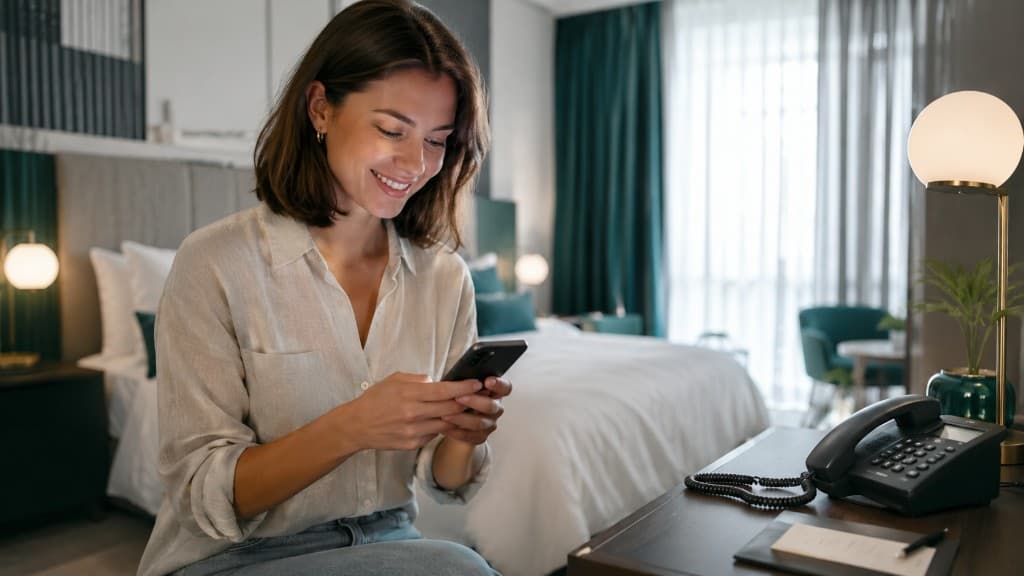
Many hotel guests prefer chat over calling because it lets them ask a question without waiting, at a time that suits them, and revisit the answer later. Chat is more discreet, less stressful, and more practical — especially for simple queries about Wi-Fi, breakfast, parking, check-out, or local recommendations.
This doesn't mean phone calls are disappearing from hospitality.
For urgent issues, complaints, or complex requests, a direct conversation is still the fastest and most human solution.
But for routine informational questions, many guests don't want to look up a phone number, wait to be connected, and explain their request out loud. They simply want to type a question and get a concrete answer.
The guest doesn't want a communication channel. They want an answer
Imagine the following situation.
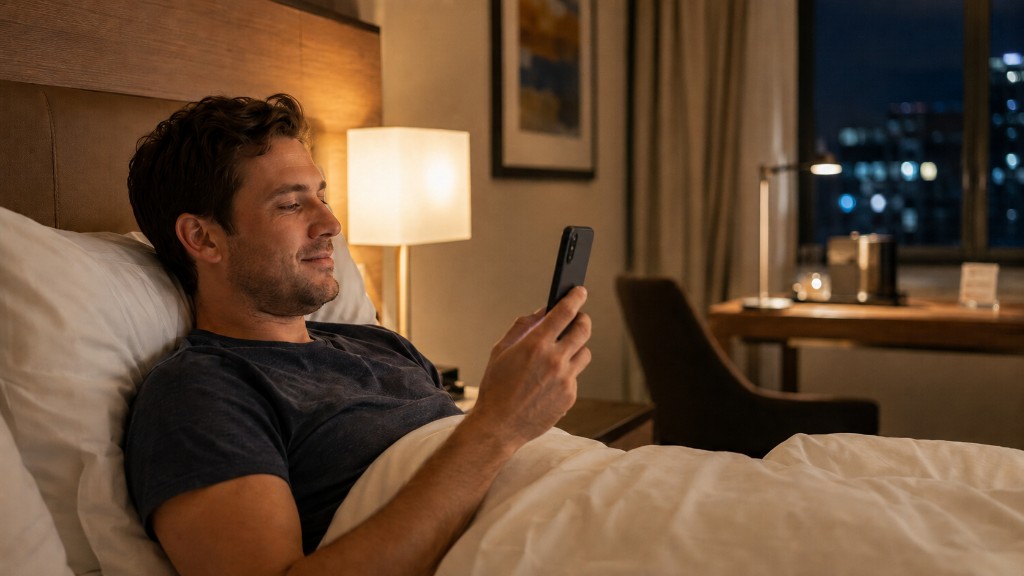
It's 10:30 PM. A guest is lying in bed and realises they need to buy medicine in the morning. They want to know where the nearest pharmacy is and when it opens.
They can:
- look up the front desk phone number,
- get dressed and go down to the lobby,
- search for pharmacies in maps,
- or type a short question into the hotel chat.
From their perspective, it doesn't matter whether they're communicating with the front desk, a digital guide, or an AI assistant.
They want a usable answer:
The nearest pharmacy is an eight-minute walk on Main Street. It opens at 7:30 AM. Here's a link to directions.
A well-designed chat shortens the path between question and answer. That's its core value.
Not all guests prefer chat
The claim that guests prefer chat isn't universally true.
Some people want to speak to a human. Others prefer to stop by the front desk in person. Preferences vary by age, situation, cultural background, and the nature of the specific problem.
There's also a difference between the question:
What's the Wi-Fi password?
and the situation:
Water is leaking in our bathroom and we need immediate help.
In the first case, chat is very practical. In the second, direct contact with a person is more appropriate.
A more accurate statement would be:
Guests often prefer chat for simple, routine, and non-urgent questions. They turn to phone or in-person communication when they need a quick decision, a human touch, or help with an unusual situation.
A generational trend exists, but it's not the whole explanation
The preference for text-based communication is more pronounced among younger guests who grew up with messaging apps, social media, and mobile communication.
A British survey by Uswitch, covered by The Guardian in an article about changing communication habits, found that 61% of respondents aged 18 to 34 preferred texting over calling. More than half of younger respondents also associated unexpected calls with bad news. This is a commercial survey, not a universal rule for all hotel guests, but it illustrates a broader shift in communication habits.
However, messaging is no longer just a Gen Z thing. According to data from regulator Ofcom, reported by Reuters in its summary of the Online Nation 2025 report, 90% of British adult internet users were on WhatsApp. This suggests that messaging is a common habit across a wide portion of the population, not just the youngest generation.
Hotels therefore don't need to introduce chat only for younger guests.
They introduce it because written mobile communication has become a normal part of everyday life.
1. Chat doesn't force the guest to interrupt what they're doing
A phone call is synchronous communication.
Both parties must be available, focused, and ready to talk at the same time.
The guest has to find the phone number, call, wait for someone to pick up, and then explain what they need. If the front desk is busy, they may have to wait or call again.
Chat works differently.
The guest types:
Can we leave our luggage at the front desk after check-out?
Then they can carry on packing, having breakfast, or getting ready to leave.
They don't have to wait with the phone to their ear. They don't need to make sure they're calling at the right moment. They don't have to fit their schedule around the other party's availability.
This ability to communicate at your own pace is one of the main reasons text-based communication feels less intrusive.
2. The guest can ask discreetly
Not every situation is suitable for a phone call.
The guest might be:
- in bed next to a sleeping partner,
- at breakfast surrounded by other people,
- in a restaurant,
- on public transport,
- on a work call,
- in the room with small children,
- in the spa or another quiet area.
Asking out loud about the Wi-Fi password, a late check-out, or a room issue may not feel comfortable.
A message can be typed silently without anyone else hearing the conversation.
This discretion also matters for more sensitive requests. A guest may want to ask about hygiene products, health restrictions, accessibility, or a problem they'd rather not discuss out loud in the middle of a hotel lobby.
Chat lowers the communication barrier in such situations.
3. A written answer stays available to the guest
A phone conversation ends and the information lives only in the guest's memory.
This can be a problem especially with detailed instructions:
- where exactly to park,
- what code to use,
- where to turn,
- what time breakfast ends,
- how to operate the air conditioning,
- how to get to a recommended restaurant.
The guest may not remember all the details correctly.
In chat, they can receive a structured answer:
The car park is in the courtyard behind the building. The entrance is on Park Lane next to the pharmacy. Hotel spaces are marked with the letter H. Here's a link to navigation.
They can come back to the message ten minutes later, show it to their partner, or follow it on their way.
Chat also allows attaching:
- a map,
- a photo of the entrance,
- a short guide,
- a navigation link,
- a menu,
- opening hours,
- a button to contact the front desk.
A written answer can therefore be more practical than a verbal explanation alone.
4. Chat makes communication easier in a foreign language
A phone call in a foreign language can be stressful for both the guest and the receptionist.
The guest must immediately understand pronunciation, respond without preparation, and correctly capture important details. Numbers, street names, access codes, or technical instructions can all cause problems.
In text-based communication, they have more time to formulate their question and read the answer.
A digital guide can also display information in the guest's language.
For example, the question:
A che ora viene servita la colazione?
can be matched by the system to verified accommodation information and answered in Italian — without an Italian-speaking staff member needing to be present at the front desk.
However, translation must not change the meaning of operational information. For important details like safety instructions, entry rules, or cancellation policies, the system must rely on an accurate and up-to-date source.
5. Chat doesn't require the guest to know the hotel's internal structure
When calling, the guest often first needs to figure out who to actually call.
The front desk? The restaurant? The spa? Technical support? The apartment owner?
In a smaller property, the contact may be obvious. In a larger hotel, less so.
A digital chat can serve as a single entry point.
The guest simply types:
We can't turn on the heating in our room.
The system recognises the topic and either offers a verified guide or passes the request to the right person.
The guest doesn't need to understand the hotel's internal organisation. They don't need to know who is responsible for a given issue.
This is an important principle of good customer experience:
The guest shouldn't have to find the right department. The property should route their request correctly.
6. Chat can be available outside operating hours
Not all hotels have a 24-hour front desk.
At guesthouses and apartments, it's common for the owner to handle enquiries personally — and in the evening they may be with family, resting, or attending to other tasks.
But guests don't stop having questions after business hours.
They may need to know:
- how to get inside,
- where to park,
- how to turn on the heating,
- whether they can arrive later,
- where a restaurant is still open,
- what to do if they lose their key.
A digital guide can answer common questions around the clock.
This doesn't mean it should try to handle every problem on its own. For urgent or safety-related situations, it must offer a clear way to reach a person.
The point isn't to create the illusion of a 24-hour front desk where none exists.
The point is to let guests get basic information without waiting for the host to read their message.
7. Guests can ask questions naturally in chat
A traditional hotel manual assumes the guest will find the right category.
They need to figure out whether their question belongs under:
- arrival,
- services,
- room amenities,
- important information,
- local recommendations.
A conversational guide works the other way around.
The guest asks in their own words:
Can we get back to the hotel after midnight?
Do you have an iron somewhere?
We need to leave at six in the morning. Can we still get breakfast?
Where can we go with the kids on a rainy day?
The system must understand the intent behind the question and find the answer in the specific property's information.
Researchers who described a real-world deployment of conversational AI for hotel search and booking showed that text-based conversational systems can operate at scale in the travel industry. At the same time, they highlighted the importance of intent classification, working with specific data, and reliable information retrieval. Chat is therefore not just a text field — behind the scenes, it needs well-designed context and data handling.
Chat isn't automatically better than a phone call
Chat has advantages only when it works well.
A bad chat can be just as frustrating as endless hold music on a phone line.
Guests are put off when, for example:
- they keep getting the same generic answer,
- the system doesn't understand a simple question,
- the answer is outdated,
- the chatbot insists on continuing at all costs,
- there's no way to reach a person,
- the guest has to fill in a long form,
- they're forced to install an app,
- the system responds too slowly,
- the information doesn't match the specific hotel.
A study on consumer responses to text-based chatbots found that trust is influenced by the perceived friendliness and empathy of the system, while acceptance decreases as task complexity grows. The practical takeaway for hotels is that chatbots work best for clearly defined informational tasks. More complex situations must be handed off to a person in a timely manner.
A well-designed chat doesn't trap the guest in automation. It helps them — or quickly connects them with someone who can.
When is chat better and when is a phone call?
Chat works well for:
- Wi-Fi password,
- breakfast times,
- standard check-out time,
- parking instructions,
- room equipment guides,
- local recommendations,
- availability of common hotel services,
- transport information,
- non-urgent requests,
- questions in a foreign language.
A phone call or in-person contact is better for:
- health or safety emergencies,
- being unable to enter the room or building,
- serious technical failures,
- complaints or conflicts,
- compensation requests,
- complex reservation changes,
- situations requiring an immediate decision,
- emotionally sensitive conversations.
A hotel therefore shouldn't force the guest to choose just one channel.
It should allow a simple question to start in chat and seamlessly escalate to a person when needed.
Does chat mean a less human hotel?
Not necessarily.
The humanity of hotel service isn't measured by the number of calls to the front desk.
It's measured by whether the guest gets help when they need it, and whether they're treated with friendliness and respect.
If the receptionist doesn't have to repeat the Wi-Fi password ten times per shift, they have more time for:
- welcoming newly arrived guests,
- handling unusual requests,
- helping a family with children,
- recommending activities,
- resolving a real problem,
- more personal interaction in the lobby.
Automating simple queries can therefore paradoxically strengthen human contact.
It removes routine and leaves staff with situations where their presence has the greatest value.
What should a hotel chat look like?
It must be easily accessible
The guest shouldn't have to dig through multiple layers of the hotel website to find the chat.
They could reach it through:
- a QR code in the room,
- a link in arrival instructions,
- the hotel website,
- a digital guide,
- a link in the confirmation message.
We describe more about connecting the room with digital information in the article How a QR Code in the Room Saves the Front Desk Hours Every Week.
It shouldn't require installing an app
For a stay of one or a few nights, most guests don't want to download yet another hotel app.
A practical solution opens directly in the mobile browser.
It must answer from the specific property's information
A generic AI may know a lot about travel, but it doesn't automatically know:
- where exactly your hotel's guests park,
- what the door code is,
- when breakfast is served on weekends,
- whether bikes can be stored,
- how the room's air conditioning works.
This information must be provided and regularly updated by the operator.
It must be able to admit uncertainty
If the system doesn't have an answer, it shouldn't make one up.
Better to say:
I don't have verified information on this. Would you like me to show you the front desk contact?
It must allow contact with a person
The escalation option shouldn't be hidden.
The guest should clearly see what to do if the automated answer isn't enough.
How does Genius Loci use chat?
Genius Loci is an AI digital guide for hotels, guesthouses, and apartments that gives guests access — via QR code — to stay information, answers to common questions, and local recommendations.
The guest doesn't need to download an app or look up the front desk phone number.
They open the guide in their mobile browser and can ask, for example:
- What's the Wi-Fi password?
- Where can we park?
- What time is breakfast served until?
- How do we get inside at night?
- How does the air conditioning work?
- Where can we go with the kids?
- Where's a good restaurant nearby?
The answer is based on the specific property's information and can be displayed in the guest's language.
We also cover the most common topics in detail in the article 5 Most Common Hotel Guest Questions.
The goal of Genius Loci is not to replace the front desk.
The goal is for the guest to get a simple answer immediately — and for the front desk to focus on situations that truly require a person.
The future isn't chat versus humans
The question isn't whether a hotel should communicate via chat or in person.
Good hotel communication needs both.
Chat is suited for quick, specific, and repetitive questions. Phone and in-person contact are important for complex, urgent, and sensitive situations.
The guest should have the option to choose whichever method suits them at that moment.
The best communication channel isn't the most technologically advanced one. It's the one that lets the guest get the right answer with the least effort.
Sometimes that will be a phone call.
But increasingly, it will be a short message.
Frequently asked questions about hotel chat
Why do guests prefer texting over calling?
Chat lets them ask a question discreetly, without waiting to be connected, and at a time that suits them. They can also revisit the written answer later.
Is chat suitable for all hotel enquiries?
No. It's best suited for routine informational questions. Urgent, safety-related, conflict-driven, or complex situations should be handled by a person.
Does the hotel have to reply to every message manually?
No. Repetitive questions can be answered by a digital or AI guide. However, it must work with up-to-date information from the specific property and allow handoff to a person.
Can chat communicate in different languages?
Yes. The guest can ask a question in their own language and receive an answer in it. Key operational information must remain accurate even after translation.
Will chat replace the hotel front desk?
No. It can reduce repetitive enquiries, but it won't replace human judgement, empathy, or help with unusual situations.
Is a hotel web chat better or WhatsApp?
It depends on the type of property and guests. A web chat doesn't require sharing a phone number or installing a specific app. WhatsApp, on the other hand, is a familiar environment for many guests. What matters more than the channel itself is the quality and availability of the answer.