
Digital Guest Guide Cost for Hotels: Solution Comparison
Compare upfront costs, ongoing expenses and business benefits across PDFs, hotel apps, AI guest guides and custom-built solutions.
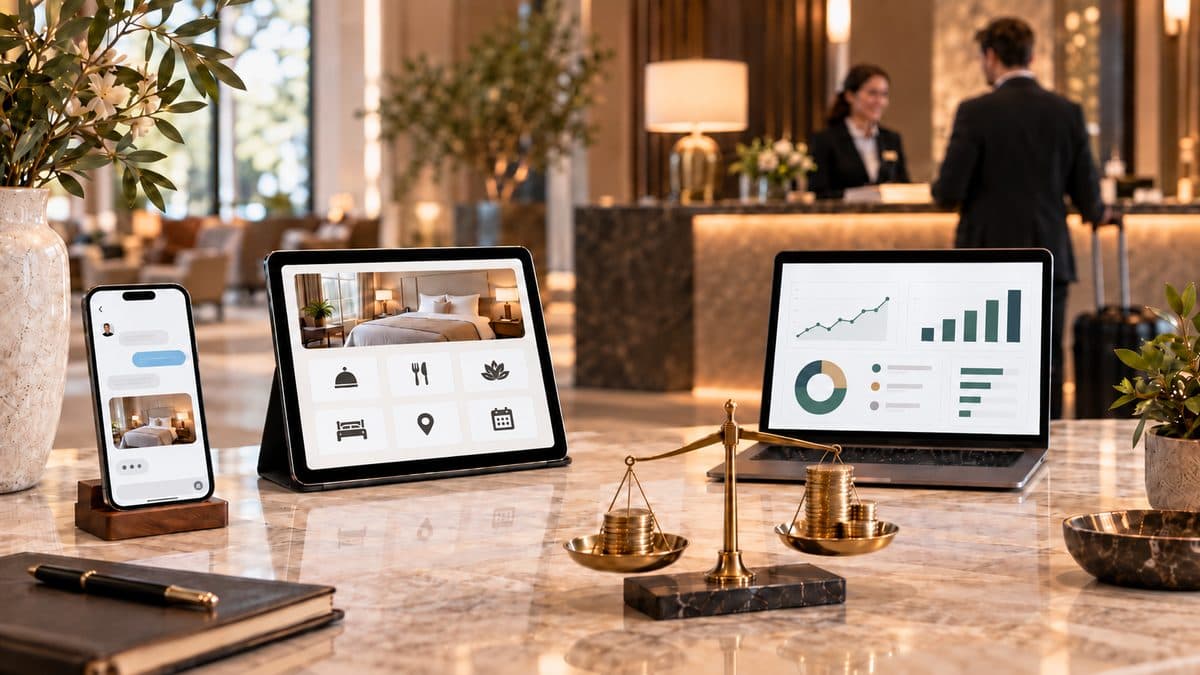
The cost of a digital guest guide includes more than a subscription or development fee. You also need to account for content preparation, updates, support, and staff time. The most cost-effective option is therefore not automatically the one with the lowest upfront price, but the solution with the lowest total cost at the required level of availability, language support, and automation.
What to Include in the Cost of a Digital Guest Guide
A digital guide provides guests with information about the property, their stay, and the local area before arrival or while they are on site. It may include arrival instructions, check-in and check-out rules, Wi-Fi details, parking information, breakfast times, air-conditioning instructions, spa facilities, transport options, or recommended restaurants. For a more detailed overview, read our article on what to include in a digital guest guide.
When calculating the cost, consider several categories:
- Upfront costs: Service configuration, development, visual customisation, content imports, or integrations.
- Recurring fees: Monthly or annual licences, hosting, technical support, and system operation.
- Internal work: Writing information, checking its accuracy, training employees, and keeping content up to date.
- Translations: Manual content translation, proofreading, or automated language processing.
- Hardware and materials: Tablets, information screens, display stands, signs, or printed QR codes.
- Additional services: Custom branding, extra properties, PMS connections, analytics, or premium support.
The licence price alone therefore says little about the total cost of ownership, or TCO. An inexpensive service may require several hours of manual work every month, while a more expensive option may automate some guest enquiries and translations.
Only compare quotations that cover the same scope. Check how many properties, rooms, administrator accounts, languages, and communication channels are included. You should also establish whether the price covers analytics, product updates, customer support, and data exports.
Five Ways to Provide Guests with Digital Information
The first option is a static PDF or simple website. It is usually straightforward to launch, and you can prepare the content yourself. The main costs are the time spent writing the information, designing the document or page, translating it, and making subsequent updates. Guests do not need to install anything, but they must find the relevant information themselves. If they phrase their question differently or need clarification, the enquiry will usually still end up with reception or the property manager.
A no-code online guide offers a clearer structure, mobile-friendly presentation, and easy editing without a developer. You will generally pay a subscription as well as the cost of the time needed to manage individual pages, categories, and language versions. Guests still have to navigate a predefined menu to find what they need.
A hotel mobile app can provide more than information. It may also support service bookings, notifications, digital room keys, or a loyalty programme. However, the overall cost must include implementation, ongoing maintenance, updates for mobile operating systems, and promotion of the app to guests. Installation creates an additional step that may not appeal to someone staying for only one or two nights.
An AI guide in a web chat can answer questions written in the guest’s own words. Instead of looking through a menu for a section called “Parking,” a guest can ask whether they may leave their car at the hotel after check-out. The answer is generated in response to that specific question using approved property information. Genius Loci is one example of this type of guide: guests open it through a QR code without installing an app. Its suitability still depends on the property’s operations and the quality of its knowledge base.
The final option is a custom-built solution. This gives you the greatest control over features, design, and integrations, but it also requires development, testing, hosting, security management, and long-term maintenance. The practical differences between the basic formats are also explored in our comparison of an AI chatbot, printed manual, and PDF.
Comparing the Costs and Features of Different Solutions
The following table uses relative cost levels. An actual quotation will always depend on the required features, number of properties, implementation scope, and the amount of work handled by the supplier.
| Solution | Upfront investment | Recurring costs | Management time | Multilingual support | Open-ended questions | Analytics | What the guest must do |
|---|---|---|---|---|---|---|---|
| PDF or simple website | Low | Low | Medium with multiple versions | Manual translations | No | Minimal | Open a link and search |
| No-code guide | Low to medium | Low to medium | Low to medium | Depends on the plan and setup | Usually not | Basic to intermediate | Browse a menu |
| Mobile app | Medium to high | Medium to high | Medium | Depends on implementation | Depends on features | Intermediate to advanced | Download and open the app |
| AI guide | Low to medium | Medium | Low to medium | Usually automated | Yes | Intermediate to advanced | Open the chat and ask a question |
| Custom development | High | High | High | As specified | As specified | As specified | Depends on the chosen interface |
You cannot directly compare the monthly subscription for a standardised service with only the quoted programming cost of a custom application. A custom solution also requires analysis, design, testing, fixes, hosting, security, updates, and continued access to people who understand the system. With a subscription service, some or all of these items may be included in the plan—but this should never be assumed.
Before accepting a quotation, divide the features and activities into three groups:
- Included in the base price, such as a content editor, QR-code access, or standard analytics.
- Paid add-ons, such as integrations, a custom domain, tailored branding, or premium support.
- Tasks handled internally, such as content creation, answer checking, and updates to operational information.
Pay particular attention to limits on the number of properties, messages, languages, and administrators. An entry-level plan may be economical for one guesthouse but poor value for a hotel group if each property requires a separate licence.
Also check what happens when your requirements grow. A low initial price may be less attractive if the next pricing tier is triggered by a relatively small increase in guest enquiries, rooms, users, or language versions.
How to Calculate Total Costs for the First Year and Beyond
Use a simple formula when comparing your options:
TCO = implementation + licences + internal work + updates + support + integrations + materials
Calculate the total separately for the first year and for each subsequent standard year. The first year will include one-off expenses such as initial configuration, content creation, translations, training, and any necessary technical connections. Later years will usually retain licence fees, information reviews, support, and routine operational maintenance.
You can build your own model using the following variables:
- S = setup cost quoted by the supplier,
- L = monthly licence fee × number of months,
- H = internal hourly staff cost,
- P = hours required for initial content preparation,
- U = number of annual updates × time required for each update × H,
- T = staff training time × H,
- I = cost of integrations and technical support,
- M = production cost of QR cards, signs, or other materials.
The first-year TCO can then be expressed as S + L + (P × H) + U + T + I + M. For the following year, remove the one-off items but retain licences, reviews, support, and the replacement of damaged or outdated materials. This is not an industry-average cost calculation. It is a template into which you should enter your actual payroll costs and supplier quotations.
Remember to include the time needed to write and review the knowledge base. Information about parking, arrival, breakfast, or property rules must be checked and approved by someone who understands the operation. For a more detailed breakdown, see our guide to how much an AI hotel guide costs.

Your hourly cost should reflect more than an employee’s basic wage. Where appropriate, include employer costs, management time, and the opportunity cost of taking staff away from other tasks. If a senior manager has to approve every update, that review time belongs in the calculation as well.
You should also distinguish between predictable and variable costs. A fixed monthly licence is easy to budget for, while translation work, additional integrations, message-based charges, or emergency development can vary considerably. Ask suppliers which fees are fixed and which depend on usage.
Benefits That Do Not Appear on the Price List
The financial value of a digital guide cannot be calculated from the licence price alone. Repetitive work at reception or in the property management team is equally important, particularly when the guide can eliminate it or reduce the time it takes. There is no universal figure for the number of hours saved: a city hotel with a 24-hour front desk receives a different volume and type of enquiries from a self-service apartment.
Before implementation, track the following information for one or two representative operating weeks:
- the number of repeated questions,
- the main subjects of those questions,
- the approximate time needed to provide each answer,
- the language in which each guest communicated,
- enquiries received outside reception or support hours.
After launching the guide, continue monitoring the same data alongside guide usage. Compare like with like, as seasonal differences in occupancy and guest profiles can distort the result.
For example, a guide that saves only a few minutes per question may still create a meaningful benefit when the same question is asked dozens of times each week. Conversely, a solution with impressive automation features may deliver little value if guests rarely need assistance or do not use the available access point.
Round-the-clock availability, consistent explanations of property rules, and the ability to assist guests in their own language may also be valuable. Question analytics can reveal which instructions are unclear. Frequent questions about operating the heating may not simply indicate a lack of information; they may point to a confusing control panel or a missing label in the room.
Analytics can therefore support operational improvements beyond guest communication. If many guests ask where to park despite receiving arrival instructions, the underlying problem may be poor signage or an unclear route. If check-out questions remain common, the timing or wording of pre-departure messages may need to change.
Include risks in your evaluation as well. An outdated knowledge base may give guests incorrect opening times, access instructions, or property rules. Review data protection, supplier dependency, export options, and the service termination process. The system should also be able to admit when it does not know an answer and hand complaints, safety concerns, emergencies, or individual requests over to a person.
Reliability matters as much as the number of features. Check how guests access information if the service is temporarily unavailable, who is responsible for restoring it, and whether critical arrival instructions are available through a backup channel. A digital guide should reduce operational risk rather than create a single point of failure.
Which Solution Is Right for Your Type of Property?
Do not base your choice only on the number of rooms. A small apartment building with contactless arrivals, international guests, and complicated parking arrangements may have more demanding information needs than a larger hotel with a front desk open around the clock.
Choose a PDF or simple website if information changes only occasionally, guests ask few follow-up questions, and limited interactivity is acceptable. It can be a practical entry-level option for a holiday home or small rental property with straightforward stay instructions.
A no-code guide makes sense if you need professionally organised content, quick editing, and several themed sections. It works well when guests are comfortable navigating a menu and you do not need the system to answer questions phrased in an unrestricted way.
Consider an AI guide if you accommodate international travellers, do not have a 24-hour reception desk, repeatedly receive the same questions, or want to analyse what guests are actually looking for. When assessing an AI guide for hotels, focus particularly on the sources used to generate answers, knowledge management, and the ability to hand a complex situation over to an employee.
A mobile app or custom-built solution is justified when you need a broader digital ecosystem, such as digital keys, a loyalty programme, service orders, push notifications, or deep integration with internal processes. The need to provide information alone is usually not a sufficient reason to commission complex development.
One practical selection criterion is the number of operational variations you need to manage. If you have different breakfast times, several buildings, multiple parking arrangements, and seasonal rules, you need a solution that allows precise control over content. For a simple operation, the same level of functionality may be unnecessarily expensive.
The guest journey should influence the decision too. Consider when guests are most likely to need information: before arrival, at the entrance, in their room, or during their stay. A solution that is easy to manage but difficult for guests to access will not deliver the expected value.
You should also assess the communication habits of your typical guests. Some audiences are comfortable downloading an app, while others prefer opening a browser link or scanning a QR code. The best solution is one that fits both your operational processes and the behaviour of the people who stay with you.
Checklist Before Choosing a Supplier
Ask every supplier to answer the same questions:
- How does the price change according to the number of rooms, properties, languages, users, or messages?
- Is a long-term commitment required?
- Is a trial period available, and what can be tested during it?
- Which features are included, and which are charged separately?
- Who prepares, checks, and updates the content?
- How quickly can incorrect information be corrected?
- Are answers based exclusively on an approved knowledge base?
- Can content, analytics, and change history be exported?
- What happens to the data after the service ends?
- How does the system escalate non-standard situations to a person?
During testing, use real guest questions, including spelling mistakes, ambiguous wording, and different languages. Also ask a question for which the system has no answer and make a request that must be handled by reception. Your internal work will include preparing a knowledge base for the AI guide, so test how practical and time-consuming the editor is.
Do not limit testing to ideal questions copied from your own content. Guests may combine several requests in one message, use informal expressions, refer to local landmarks, or omit important details. The test should show whether the system asks for clarification, provides a safe answer, or correctly redirects the guest.
A short pilot at one property or in one part of the operation is ideal. Define your criteria in advance: answer accuracy, guest adoption, management time, the number of unresolved topics, and actual annual TCO. Choose according to total cost, operational value, and the ability to keep information current—not simply the lowest monthly subscription.
Document who will own the system after the pilot. Even a highly automated guide needs someone responsible for approving changes, reviewing analytics, and checking time-sensitive information. Without clear ownership, content quality is likely to deteriorate regardless of the technology selected.
Frequently Asked Questions About the Cost of a Digital Guest Guide for Hotels
How much does a digital guest guide for a hotel cost?
The price depends on the type of solution, number of properties, features, integrations, and the work required to prepare the content. For example, Genius Loci lists pricing from €18 per month, while a mobile app or custom-built system requires an individual quotation. Always compare total costs for the first year and for a typical subsequent year.
The advertised starting price may not include onboarding, extra properties, premium support, integrations, custom branding, or higher usage. Request a written breakdown based on your actual requirements rather than relying only on the headline price.
Is an AI guide, hotel app, or PDF cheaper?
A PDF is usually the least expensive option to launch, but it cannot answer open-ended questions and may leave more work for your staff. A standardised AI guide generally does not require the development of a mobile application, while an app tends to make financial sense when the property will use its broader features and integrations.
The cheapest option in the first month is not necessarily the least expensive over several years. Content maintenance, translation, staff time, technical updates, and guest adoption can significantly change the total cost.
Which hidden costs should be included?
Include content creation and review, translations, employee training, updates, support, integrations, and the production of QR-code materials. For custom development, add hosting, security, testing, bug fixes, and long-term technical maintenance.
You should also budget for management oversight, data migration, content exports, replacement signs, and any work required when changing supplier. Usage-based charges and the cost of moving to a higher subscription tier can also become important as adoption increases.
Is a digital guide worthwhile for a small hotel?
It can be worthwhile if guests repeatedly ask the same questions, if you welcome international travellers, or if reception is not always available. The number of rooms is not the only deciding factor. Operational complexity, communication volume, and the staff time needed to assist guests are more relevant.
A small property may gain substantial value from a digital guide when arrivals are self-service, parking is difficult to explain, or the owner handles enquiries personally outside normal working hours. Measure the actual communication workload before deciding.
How should I compare quotations from different AI guide suppliers?
Prepare the same list of features, properties, languages, integrations, and support requirements for every supplier. Calculate TCO for each quotation, test genuine guest questions, and review knowledge-base management, analytics, usage limits, data exports, and the ability to escalate an enquiry to a person.
You should also compare contract length, cancellation terms, onboarding support, update procedures, and what happens to your content when the service ends. A pilot using real operational data will provide a more reliable comparison than a sales demonstration alone.