
AI Chatbot, Printed Manual or PDF: What Guests Actually Use
A comparison of AI chatbots, printed hotel manuals, and PDF guides — what guests actually use and when each option makes sense.
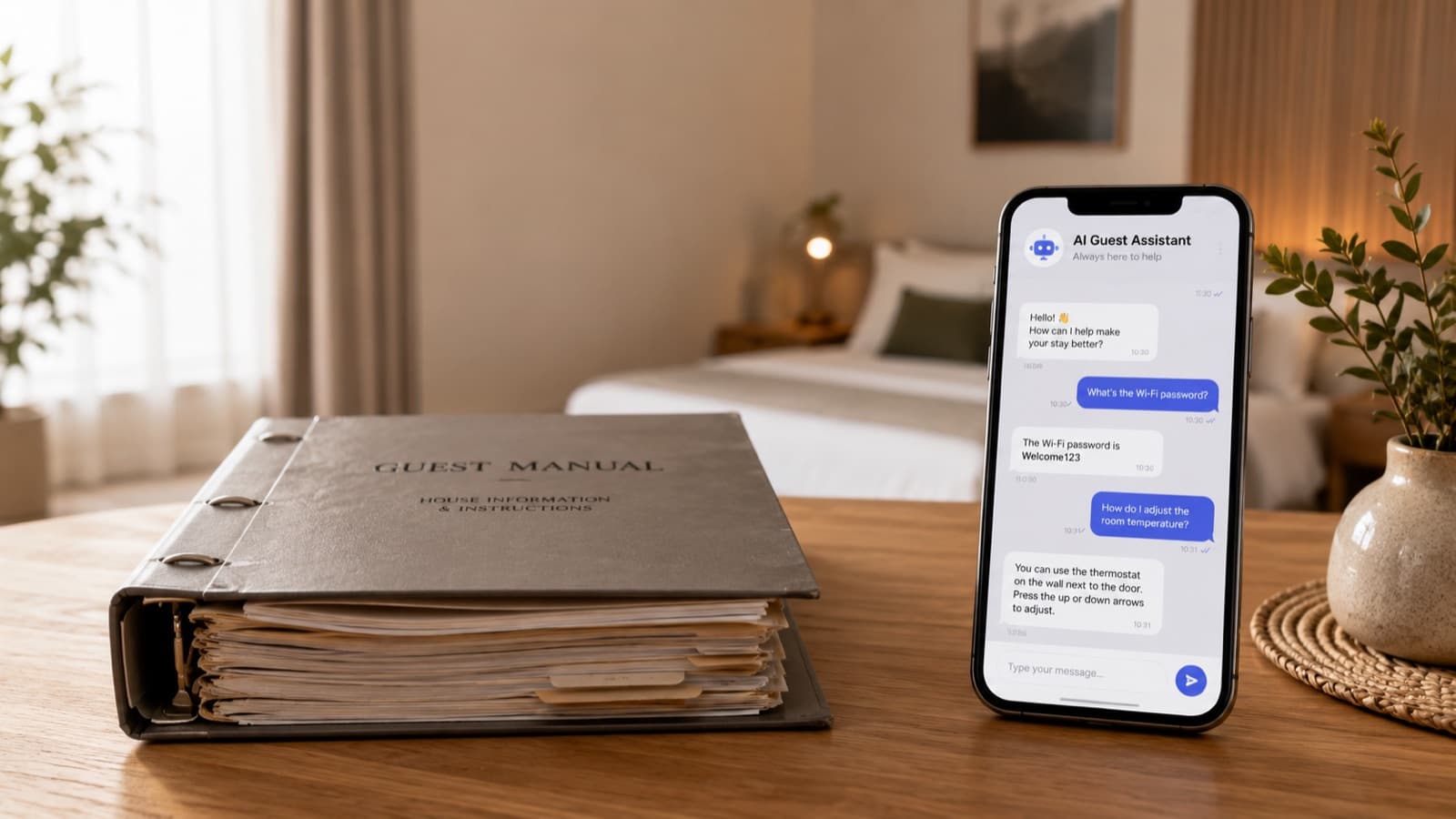
Every accommodation faces the same question: how do you give guests information about Wi-Fi, checkout, parking, and the neighborhood — in a way they actually find when they need it?
The three most common answers: a printed manual on the desk, a PDF emailed before arrival, or an AI chatbot accessible via QR code. Each looks reasonable on paper. In practice, they differ in whether guests open them at all — and whether they find the answer at the moment they need it.
Three Ways to Deliver Information to Guests
| Printed manual | PDF by email | AI chatbot | |
|---|---|---|---|
| Where guests find it | On the desk / by the bed | In their inbox before arrival | QR code in the room / link |
| Updates | Reprint a new version | New file + resend | Edit the knowledge base |
| Languages | As many as you print | As many as you translate | 100+ automatically |
| Finding answers | Flipping pages | Scrolling / Ctrl+F | Asking a question |
| Outside the property | No | Only if they have the email | Yes — on their phone anywhere |
| Cost | Printing + updates | Time to create the PDF | Monthly subscription |
Why Guests Don't Use Printed Manuals
A printed hotel manual has one advantage: it's physically in the room. The guest doesn't have to dig through email.
It also has serious drawbacks:
- Nobody reads it cover to cover. Guests look for one specific piece of information — the Wi-Fi password, breakfast time. In a 20-page booklet, they often don't find it.
- Updates cost money. A change in restaurant hours means a new print run for every room.
- One language isn't enough. International guests ignore a Czech or English-only manual if it isn't in their language.
- It stays in the room. When a guest is standing at the entrance looking for a door code, the manual on the nightstand doesn't help.
A paper manual still works as a backup. As a primary information source in 2026, it falls short.
PDF Guides: Better Than Paper, Still Passive
Many hosts switched to PDF — emailed 24 hours before arrival. It's a step forward: easier updates, more languages, no printing.
The problem is elsewhere. Guests often:
- never open it — the email gets lost between the booking confirmation and the invoice,
- open it once before arrival and never return to it,
- can't quickly find a specific answer when they need it (standing in front of the AC, looking for parking).
A PDF is a static document. The guest has to know what they're looking for and where it is in the file. With a 15-page guide, that isn't trivial.
We've covered separately what a digital guest guide should include.
AI Chatbot: Guests Ask, Get an Answer
An AI chatbot (or AI digital guide) works differently. Guests don't browse content — they ask a question in natural language and get an answer from that property's information.
Typical flow:
- The guest scans the QR code in the room.
- They ask: "What's the Wi-Fi password?"
- They get an answer in seconds — in their own language.
The same pattern covers the 5 most common guest questions: parking, breakfast, checkout, air conditioning, local recommendations.
Unlike PDF and paper, a chatbot:
- doesn't require searching — the guest asks,
- works 24/7 without front-desk staff present,
- replies in the guest's language automatically,
- updates in one place — a knowledge-base change applies instantly for all guests.
This is how Genius Loci AI guide for hotels works, for example.
Chatbot Outside the Property: An Advantage PDF Can't Match
Printed manuals and PDFs are tied to a physical place or an email inbox. An AI chatbot lives on the guest's phone — even when they're not in the room.
Picture a guest out on a bike ride. They get lost, want to know how to get back, where the nearest bike repair shop is, or how late the hotel restaurant is open. The printed manual is on the desk. The PDF is somewhere in their email — if they opened it at all. The chatbot is on their phone. They just ask.

The same applies on a city walk, at the beach, or when looking for a dinner spot. Property and local information travels with the guest — something paper and PDF can't offer.
What Guests Actually Use: A Practical Comparison
Operational data from hotels and short-term rentals shows a consistent pattern:
| Situation | What the guest does |
|---|---|
| Info is on the desk (paper) | Sometimes opens it, often skips it |
| Info arrived by email (PDF) | Opens before arrival, then forgets |
| Info is behind a QR code (chat) | Asks at the moment of need |
The key difference isn't technology. It's moment of use. Guests don't want to study a manual. They want an answer now.
That's why guests prefer chat over calling the front desk — and for the same reason they prefer chat over scrolling a PDF.
When Each Option Makes Sense
That doesn't mean paper and PDF are useless. Context matters:
A printed manual makes sense as:
- a backup when Wi-Fi is down,
- a short card with the Wi-Fi password and QR code,
- a visual room element (not a 20-page booklet).
A PDF makes sense as:
- detailed pre-arrival information (check-in instructions, how to get there),
- a complement to an AI guide, not a replacement.
An AI chatbot makes sense as:
- the primary answer source during the stay,
- a solution for guesthouses and apartments without a staffed front desk,
- support for international guests without manual translations.
Best practice? Combine them: a short printed card with a QR code + an AI guide. Paper leads the guest to the answer. The chatbot delivers it.
Common Objections to AI Chatbots
"Guests won't use it"
Guests already use chat — WhatsApp, Booking messages, Airbnb. A QR-code chatbot follows the same pattern: open, ask, get an answer. The barrier is lower than with a PDF.
"We'll have to rewrite all our content"
No. Most properties already have the information — in a PDF, on the website, or in the owner's head. Moving it into an AI guide's knowledge base is a one-time job. After that, you update it in one place.
"It's expensive compared to a PDF"
PDF is only "free" at first glance. Time spent creating, translating, sending, and updating adds up. An AI guide has a monthly fee but saves front-desk hours every week — see how a QR code saves time at reception.
"AI will give wrong answers"
Quality depends on the knowledge base. A well-configured guide answers only from your data and can say "I don't know" — then pass the guest a front-desk contact. That's different from generic ChatGPT.
Checklist: Which Option to Choose
- Do you have repetitive questions that eat staff time? → AI chatbot
- Do you need information available outside the room? → AI chatbot (not paper)
- Do you have international guests in many languages? → AI chatbot
- Do you only need to send check-in instructions before arrival? → PDF works as a complement
- Do you need an offline backup? → Short printed card + QR
Frequently Asked Questions About AI Chatbots, Manuals, and PDFs
Is an AI chatbot better than a hotel manual?
For most situations during the stay, yes — guests ask and get an answer instead of flipping pages. A printed manual still makes sense as a backup or a short card with a QR code.
Why don't guests open PDF guides?
The email gets lost among confirmations. Even if they open the PDF before arrival, they don't look for it during the stay. At the moment of need, scanning a QR code is easier than hunting an old email.
Can a chatbot replace the front desk?
No. It replaces repetitive informational questions. Complex, urgent, and sensitive situations belong to a person. The goal is for staff to handle what actually requires a human.
Does an AI guide work outside the hotel?
Yes — unlike a printed manual or PDF, it's available on the phone anywhere. Guests can ask on the road, on a day trip, or while looking for a restaurant in town.
How much does switching from PDF to an AI chatbot cost?
The upfront work is mainly moving existing information into a knowledge base (one-time). Ongoing cost is a monthly subscription — for smaller properties often lower than printing and translating manuals.
Sources and Further Reading
- Digital Guest Guide: What It Is and What It Should Include — what belongs in a guide
- How a QR Code Saves Hours at Reception — how to get guests to the guide
- 5 Most Common Guest Questions — what guests actually ask
- Why Guests Prefer Chat Over Calling — why chat works better than phone
- Genius Loci for hotels — AI guide for hotel operations
- Phocuswright / Booking.com travel trends — traveler preferences for digital services