
Digital Guest Guide: What It Is and What It Should Include
A complete overview of digital guest guides — why they replace printed manuals and what they should contain so guests never need to call the front desk.
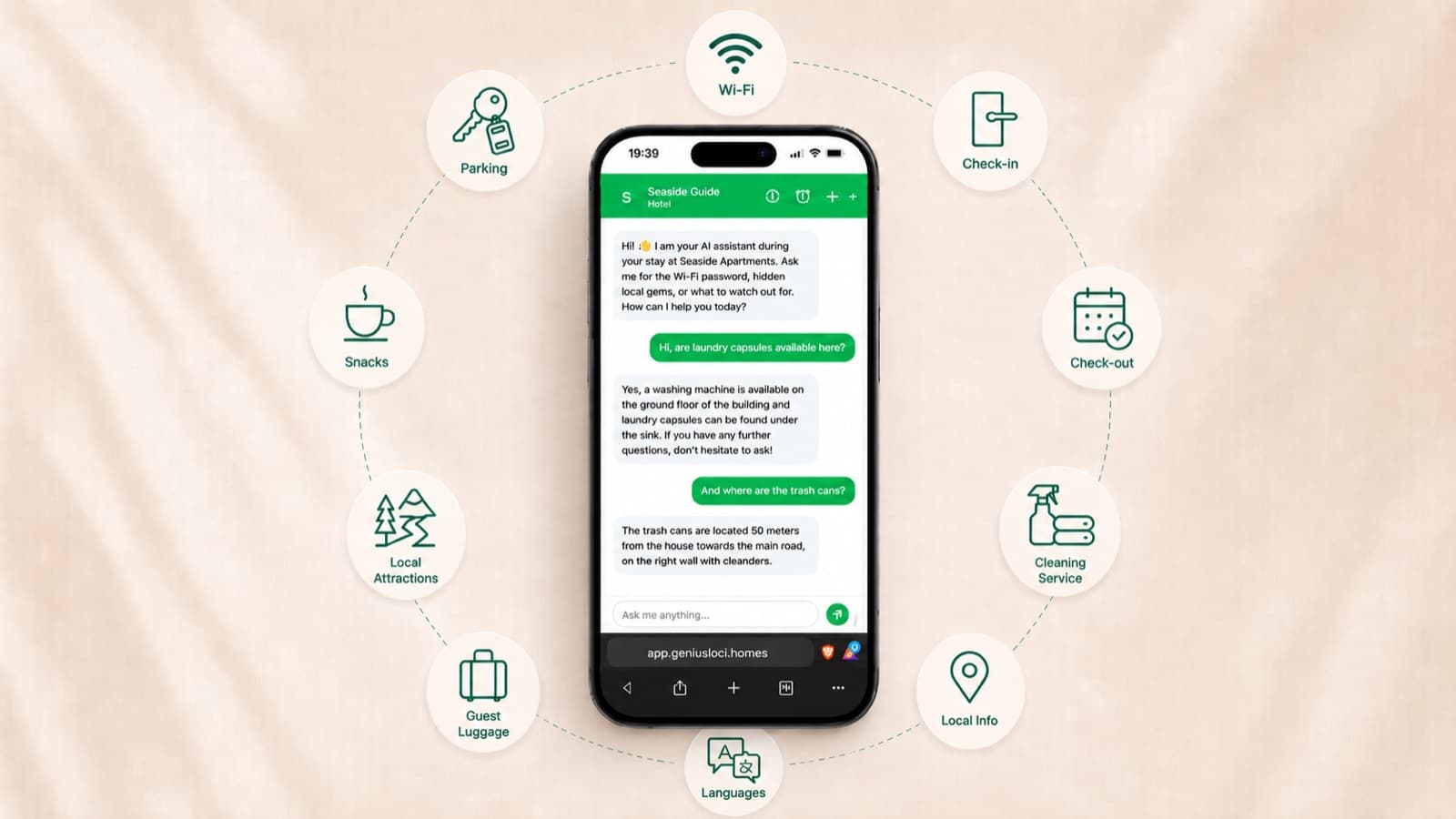
Most questions guests ask at the front desk or send via message are repetitive. Wi-Fi password, breakfast hours, how the air conditioning works, where to eat dinner, where to park. They might read a fraction of what's on the printed card in the room. The PDF sent before arrival? Most never open it.
A digital guide solves this differently. It gives guests access to all practical information about the accommodation the moment they need it — without downloading an app, digging through email, or making a phone call.
What Is a Digital Guest Guide?
A digital guest guide is an online source of accommodation information that guests access via a link, QR code, or web page. Instead of a printed manual on the nightstand, it offers up-to-date, searchable, and ideally multilingual information.
It can take various forms:
- Static web page — a simple overview of information without interaction.
- PDF document — a classic hotel manual in digital form.
- Interactive chatbot / AI guide — the guest asks a question in natural language and receives a specific answer from a prepared knowledge base.
The last option is the most effective today — the guest doesn't have to search for anything, they simply ask. This is exactly how Genius Loci AI guide for hotels works.
Why Printed Manuals Don't Work
Printed materials in rooms have several limitations:
| Problem | Consequence |
|---|---|
| Outdated information | Guest follows invalid data (e.g. opening hours, prices) |
| Single language only | Foreign guests can't use them |
| Nobody reads them cover to cover | Guest needs 1 answer, not a 12-page document |
| Printing costs | Every change = new expense |
| Hygiene | Post-Covid, guests prefer not touching shared materials |
According to an Oracle Hospitality study, 73% of guests prefer digital self-service over personal contact for routine matters.
What Should a Digital Guide Contain?
Content depends on the accommodation type, but the basic structure is universal:
1. Practical Room / Unit Information
- How the air conditioning, heating, and blinds work
- Wi-Fi password
- How to use the TV, speaker, safe
- Where to find extra pillows, blankets, towels
- How the shower / bathtub works (especially for non-standard setups)
2. Accommodation Services
- Breakfast — hours, location, type (buffet/à la carte), allergy options
- Reception — opening hours, contact
- Wellness, gym, pool — operating hours, rules
- Laundry, ironing
- Luggage storage
- Late check-out — conditions
3. Surroundings and Recommendations
- Restaurants and cafés (with approximate distance)
- Shops, pharmacy, ATM
- Transport — public transit, taxi, parking
- Tourist attractions and activities
- Day trip suggestions by season
4. Problem Resolution
- What to do during a power outage
- Who to call in an emergency
- How to report a malfunction
- Procedure for lost key / card
5. Check-out Information
- Check-out deadline
- Where to return the key / card
- How express check-out works
- Invoicing, city tax
How Do Guests Access the Guide?
The most effective distribution combines multiple channels:
- QR code in the room — on the desk, by the bed, in the bathroom. Guest scans it and the guide is instantly available.
- Link in the booking confirmation — pre-arrival email with a guide link.
- Link in a welcome SMS / WhatsApp message — short message at check-in.
- Wi-Fi captive portal — after connecting to the network, a link appears.

According to research by Criton, 62% of guests prefer accessing information via their phone over any other channel.
How Does a Digital Guide Differ from a Hotel App?
Hotel apps require downloading from the App Store, registration, and often only work for chains with large budgets. A digital guide, by contrast, is:
- No installation — just a link or QR code
- No registration — the guest doesn't need to sign up anywhere
- Instantly available — works on any phone with a browser
- Easy to update — changes reflect immediately, without releasing a new version
For guesthouses and smaller accommodations where a dedicated app doesn't make sense, a digital guide is the ideal solution.
AI Guide vs. Static Digital Manual
A basic digital guide (a list of information on a website) is better than paper, but still requires the guest to find the answer themselves.
An AI guide adds one crucial layer: the guest simply asks.
| Static guide | AI guide | |
|---|---|---|
| Searching | Guest browses categories | Guest asks a question |
| Language | Fixed number of languages | Responds in guest's language (100+ languages) |
| Updates | Manual rewriting | Knowledge base edit |
| Availability | 24/7 | 24/7 |
| Personalization | None | Contextual answer (room type, season) |
| Feedback | None | Analysis of common questions |
Learn more about how AI handles the most common guest questions.
How to Start — 5 Steps to Your Own Digital Guide
- List the most common questions — review your message history, emails, and front desk logs from the past month.
- Organize information into categories — room, services, surroundings, problem resolution, check-out.
- Choose the format — for smaller accommodations, an AI guide with its own knowledge base (e.g. Genius Loci for guesthouses) is sufficient; for larger hotels, consider PMS integration.
- Place QR codes — in rooms, at reception, in the elevator. Simple, zero operating costs.
- Monitor what guests ask — and continuously expand the knowledge base.
What Results to Expect?
Accommodations that have deployed a digital guide typically report:
- 40–60% fewer repetitive questions at the front desk (source: Hospitality Net)
- Higher guest satisfaction — fast answers without waiting
- Better reviews — guests appreciate the modern approach and information availability
- 5–10 hours saved per week on routine communication for a mid-size hotel
Frequently Asked Questions About Digital Guest Guides
What is a digital guest guide?
A digital guest guide is an online source of accommodation information accessible via QR code, link, or web. It replaces printed manuals in rooms and gives guests answers to practical questions whenever they need them — without calling the front desk.
How much does a digital guide cost for a hotel?
It depends on the format. A static page can be free (self-built). An AI guide as a service typically costs €12–49/month depending on room count and features. ROI is usually within the first month due to saved staff time.
Do guests need to download an app?
No. Modern digital guides work as a web page — just scan a QR code or click a link. No installation, no registration required.
How many languages can a guide support?
Static guides work in the languages you translate them into. An AI guide based on a large language model (like Genius Loci) responds in over 100 languages automatically — the guest asks in their language and gets an answer.
How long does setup take?
With an AI guide on a ready-made platform, typically 30–60 minutes. You write information about your accommodation, upload it to the knowledge base, generate a QR code — and you're done.
Sources and Further Reading
- Oracle Hospitality: Hotel Trends & Guest Expectations — research on guest preferences for digital services
- Criton: Guest App Research 2024 — data on guests' mobile access to information
- Hospitality Net: Digital Guest Communication — impact of digital guides on operations
- Skift: Hospitality in 2025 — automation trends in hospitality
- How a QR Code Saves Hours at Reception — our article on the QR distribution channel
- 5 Most Common Guest Questions and How AI Can Solve Them — practical examples of automation